US job growth stalls: Just 73,000 jobs added in July, with ‘stunning’ downward revisions to recent months
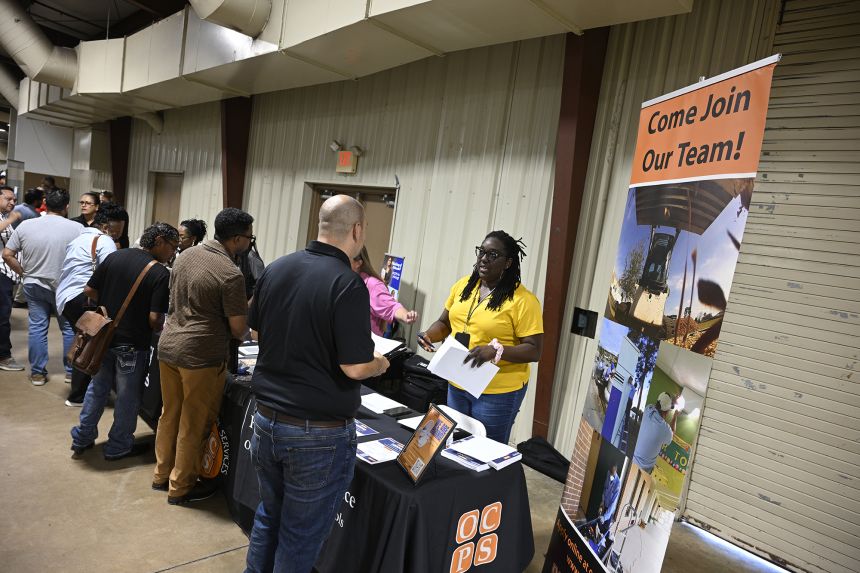
The US job market slowed sharply in July and was substantially weaker than first estimated for prior months, suggesting President Donald Trump’s trade policy may be stifling hiring.
The US economy added just 73,000 jobs last month, and the monthly totals for May and June were revised down by a combined 258,000 jobs.
The prior two months’ revisions were “stunning,” said Diane Swonk, chief economist at KPMG, in an interview with CNN.
“It’s stalling out right now,” Swonk said of the labor market.
With those monumental, quarter-million-job downward revisions, the meager job gains in June were the weakest since December 2020, the last time the labor market had monthly job losses. The pace of job creation seen so far this year is the weakest in decades, outside of recessions.
“This is absolutely the worst major economic report since the end of the pandemic era,” Joe Brusuelas, chief economist at RSM US, told CNN.
The Dow opened lower, falling by more than 600 points, or 1.3%, by mid-morning. The broader S&P 500 fell 1.4% and the tech-heavy Nasdaq Composite slipped 1.8%. Traders now expect an 85% chance of a rate cut from the Federal Reserve in September, up from a 38% chance on Thursday, according to the CME FedWatch Tool.
Tariffs are ‘paralyzing’ employers
High uncertainty over Trump’s economic policies — specifically a volatile trade policy and shifting tariff rates — have been blamed for putting a stranglehold on employers’ growth plans.
“Tariffs and uncertainty are paralyzing employers,” Gregory Daco, chief economist at EY-Parthenon, told CNN in an interview.
Forecasts called for a gain of 115,000 jobs in July and the unemployment rate to rise to 4.2%.
However, economists weren’t expecting the past three months to be this frail.
“This (jobs report) is really bad because you can see the impact of trade and immigration policy hurting demand for hiring,” Brusuelas said.
“These trends reflect the ripple effects of trade and immigration policies impacting labor supply, especially where migrant workers are key,” he added.
In recent months, despite the labor market registering solid (but slower) gains, economists were sounding some alarm bells: The all-important labor market churn was grinding to a halt, and a smaller and smaller subset of industries was responsible for the job gains.
That lack of breadth was wildly apparent in July: Health care and social assistance, which added 73,300 jobs, accounted for the entirety of the month’s overall gains.
“A one-legged stool is dangerous,” she added.
Leisure and hospitality, which typically sees a summertime boom, added a meager 5,000 jobs in July. June’s gains were revised down to 4,000, BLS data shows.
“That’s almost within the margin of error,” Swonk said. “That reflects a slowdown in domestic travel and tourism.”
And as for that labor market churn (or lack there of), Friday’s jobs report showed that the average duration of unemployment rose to 24.1 weeks (north of six months), the lengthiest average span in more than three years.
Why is the jobs data revised?
The US labor force is shrinking. It’s done so for three months in a row now, and in July, the unemployment rate rose as a result.
But before delving into labor market dynamics, it’s worth stepping back and highlighting some of the nitty-gritty about how the jobs report is structured.
The BLS’ monthly snapshot of the labor market is composed of two surveys: One of households (which provides demographic data and feeds into the all-important unemployment rate) and the other of businesses (designed to measure employment, hours and earnings).
The household survey, which provides demographic data and feeds into the unemployment rate, is considered more volatile because of its smaller sample size and declining response rates. The establishment survey is responsible for the monthly estimates of how many jobs were added or lost.
When the market-moving jobs report is released, that initial estimate is often based on incomplete data and thus will be revised twice further in the two jobs reports that follow as the BLS receives more complete information from businesses.
But then it’s eventually revised even further: The bigger, annual revision (which takes place each February jobs report) will come into focus starting next month when the preliminary annual benchmarking estimates are released.
And, also keep in mind that the estimates seen in the jobs reports are adjusted to smooth out seasonal changes (think: construction jobs pick up in spring, schools are out for the summer). The adjustments anticipate a certain number of job losses or gains, so if the employment gains or losses fall outside those expectations, it can result in bigger or smaller employment gains.
Warning signs flashing
Keeping the above context in mind, there were several potential warning signs in the July jobs report:
A rise in the Black unemployment rate almost always precedes the rise in the general population unemployment rate. That’s because a higher percentage of Black Americans than Americans of other races are in temporary jobs or lower-income jobs that tend to be the first that employers cut when they grow concerned about the economy.
The labor force shrank for the third month in a row, which is the first time since 2011, according to Appcast economist Sam Kuhn. And the labor force participation rate fell to 62.2%, the lowest since November 2022.
The fall could be caused in part by stepped-up immigration enforcement; however, other factors such as an aging workforce, highly discouraged workers, and “simply mismeasurement” from lower response rates to the household survey could be factoring in to that equation, said Preston Caldwell, Morningstar’s chief economist.
Economists warn that a shrinking labor force and fewer foreign-born workers could put upward pressure on wages (and inflation), and result in hiring challenges for key industries and negative supply chain impacts as a result.
The 253,000 downward revisions to May and June was the largest since at least 1979 (with the exception of 2020), according to Ernie Tedeschi, director of economics at the Budget Lab at Yale.
The outsized correction is reflective of an extremely volatile economic environment, KPMG’s Swonk said. “The data was meant for historic norms for an economy that typically moves more slowly.”
“This type of very weak job growth momentum is essentially eroding the economy’s buffer against headwinds,” he said. “And and in an environment where the US economy is subject to historic supply shocks, that will essentially expose it to the risk of a recession.”
CNN’s Matt Egan and David Goldman contributed to this report.
Comments
Post a Comment